THE OBSERVATORY: ART AND LIFE IN THE CRITICAL ZONE

THE OBSERVATORY: ART AND LIFE IN THE CRITICAL ZONE

revolves around the intricate relationships among humans, animals, plants, earth material, and other forms of life. The exhibition brings together a collection of new and existing artworks by twenty-six artists who, in diverse ways, actively engage with the multifaceted elements present in the “critical zone.” These elements encompass a wide range, spanning from earthworms and oil birds to imagined beach creatures and resilient potatoes, from indigenous landscapes and micro-territories to rainwater and archives of rural-based alternative communities across Europe and West Asia. The artists have employed painting, drawing, video, sculpture, performance, workshops, agriculture, and other means of expression, which will co-exist in a dynamic display at Södertälje konsthall.

Residence by Hosting lands at Padenandenside

Residence by Hosting lands at Padenandenside

As a part of the project Hosting Lands, Kultivator did field work at Padenandenside (PDAS) and was invited to join in the design and construction of a water collector for the common field, many inspiring conversations on hosting, and a workshop creating new Post revolutionary exercises.   


The choir of the sheep

The choir of the sheep

A work in collaboration between the artists Marlene Lindmark and Anna Lindvall.
In her contribution to “a part of the Landscape”, Marlene Lindmark has chosen to go deep under the vegetation and humus layers of the Midland forest, to the locations in the Landscape where sediment was transported by ancient waterways and formed clay. The process of finding, cleaning and shaping local clay from the Midland is in itself a journey back to a time so far back that it is difficult to overview. Where exactly was this place a million years ago? Where does the foundation, the layers, come from? The clay as material, and perhaps also as memory, has been washed, sifted, processed and fired into tribute portraits of some of those who shape the landscape above the ground; our sheep. Sheep’s time here is also long, but more tangible than Clay’s. After all, we have been here together, and generations of other plants and animals that remember the landscape of the grazing sheep also remain, still together, albeit with new challenges.
The work “The Choir of the Sheep” takes its final form in the conversation with Anna Lindvall, who was invited as Marlene’s poetic expert in the project. With Anna’s proposal for a choral work, where a recording of the sheep’s voices is transformed into song and accompanied live in the forest by Anna on the electric organ, the artists tie together the incomprehensible volumes of time in a condensed moment. The sheep’s choir is heard and seen by us who have gathered there in the twilight for a while. A moment that becomes a memory. An experience that adds to all the geological, organic, physical and spiritual memories that built, and are still building, our landscape.
Marlene Lindmark is an artist educated at the Department of Ceramic Art at Kunsthöyskolen in Oslo. She works in drawing, sculpture and mixed media, and is represented in collections and with public works in Kalmar, Mörbylånga, Borgholm, Östersund, Växjö, Antwerp and Oslo. Marlene has also been part of Kultivator since the beginning, and also ran Galleri ML in Borgholm as well as the art exhibition operations at Öland’s museum, Himmelsberga.
Anna Lindvall is educated at the Nordic Art School in Kokkola, Finland, and the Gerrit Rietveld Academy in Amsterdam. In recent years, Anna has worked with intuitive animation based on pencil drawings, and has participated in several jury-judged collective exhibitions in the county with both drawings and film. Her practice also includes sound art and music production, both in independent productions in the borderland between art music and pop, and as parts of installations or video works.
The project is implemented with the support of the Swedish cultural council
More info here

Hjemmefra Residency

Hjemmefra Residency

The residence hjemmefra by the union Oslo, filled with mushrooms, water, new friends and warmest super power hospitality. Thank you Martinka, Oscar and Alejandra for the very productive non – productivity!

Fattmi

Fattmi

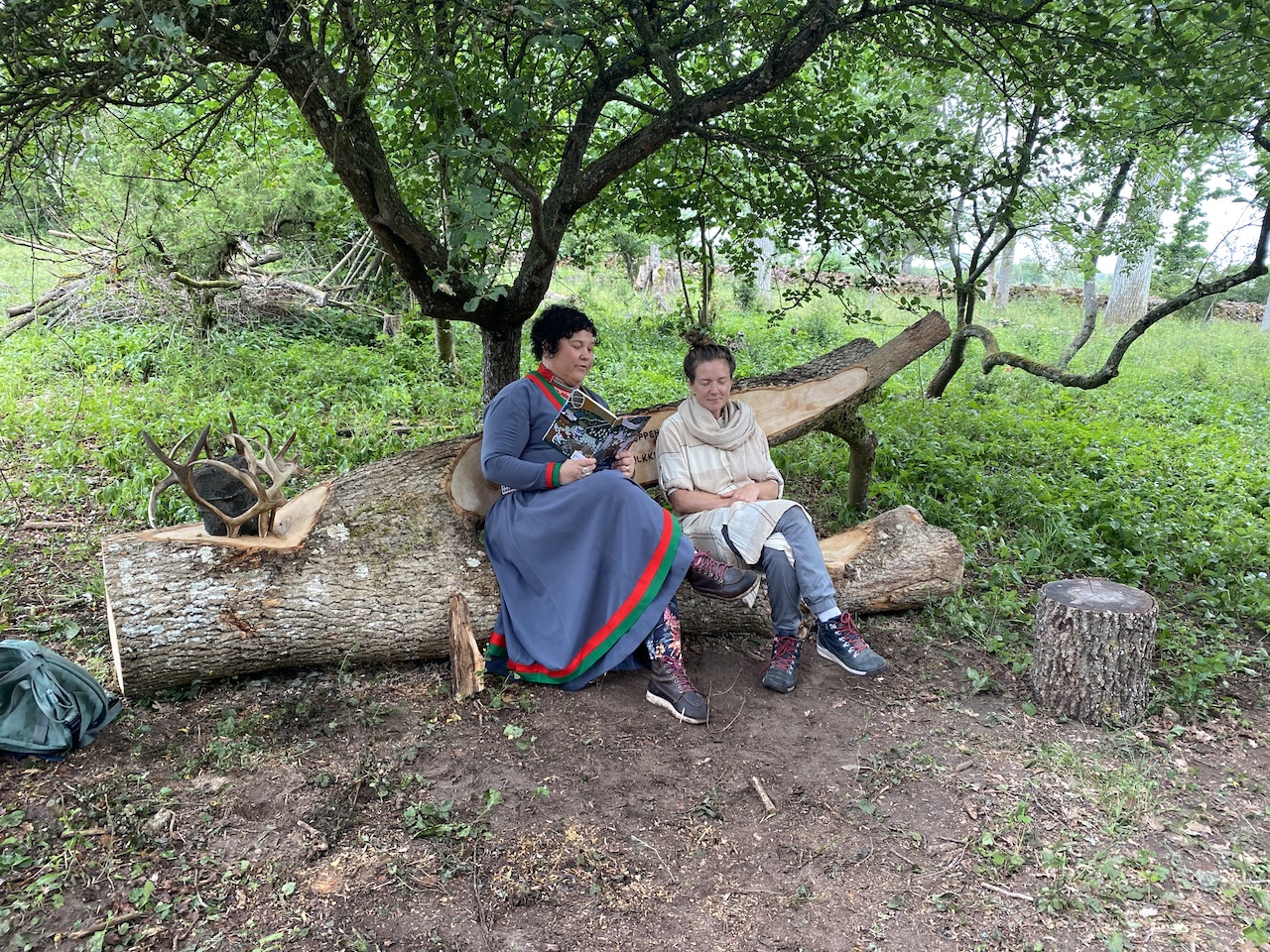
Sara Ajnnak, together with her husband Jon Andersson, is active in reindeer husbandry and they have developed a lifestyle that is guided by the annual cycle of the reindeer and the changes of the seasons. Jon Andersson is a skilled craftsman with extensive knowledge and a great interest in cultural buildings of various kinds. He has many years of experience in various restoration projects of cultural buildings such as mills, bone stomps, lodges, etc. and specific knowledge of traditional
buildings and building techniques from Västerbotten. In the Sami tradition they live in and manage, there have been and still are sacred places in nature, and Sara and Jon, through their participation in the project Part of the landscape, want to create a place for people where they can recreate their
natural relationship with nature, in the work Fátmmie – open arms. “The healing power of nature is there as an open embrace for man. In the Sami cultural tradition,
people have treated sacred places with great respect for their powers and their geographical area. Before our stay in Mittlandskogen, we have collected material from our immediate area which we combine with the geographical location on Öland. The whole family has worked on the piece together, something that is really natural when it comes to us people in the Landscape. What we do now affects the next generation, who must also be able to live with and in their surroundings.”
With support from KULTURRÅDET
More info here

Dear mana

Dear Måna

In their work for the Solarpunk arts festival of 2023 in Rjukan, the group Kultivator has focused their
interest on the river Måna and her history and possible future together with the multi-species
communities she runs through. From her past of connecting mountain lakes to the sea with a
delicate eco system of migrating life forms, moving sediments, and contributing through millennia to
the planets hydrologic cycle, going into supplying energy to what would become an industrial world
heritage, and soon about to feed Salmon farms and server halls with her harnessed powers, she is
the centrepiece of many entangled stories. What would her own say for the future be? Could we as
artists, scientists or just members of human society, begin to hear that by speculating or imagining?
In the project Dear Måna… , Kultivator initiates a correspondence with the river, a long overdue
letter, that experiments with modes of listening and giving voice, mixing familiar language with
attempts of speaking in river, having her ceaseless current as a companion in the work.
One part of the correspondence takes physical form in wet clay letters in the river bed, that
Kultivator entered on Thursday the 29:th of June. The performance of shaping the letters, lowering
them to the riverbed, and writing them in between Månas polished rocks and gravel took seven
hours. After receiving the letter, she is now doing her reading, the words are dissolving, following her
movement down through Rjukan, passing dams and turbines, perhaps landing as a thin layer on the
calm river floor in her mouth at Tinnsjøen. Only she knows for how long the text will still be readable
from Fabrikksbrua. Hopefully and probably, we will still see traces from them during the Solarpunk
arts festival summer 2023.
The sentence, “Dear Måna, How are we doing (it together in the future?)” is just the start of a letter,
and is to be continued by the visitors of the Solarpunk arts festival during the summer 2023, as
another part of the correspondence. In Rjukan Varelagret, with a view over Måna, a small Office of
experimental river communication is set up. Here anyone who wish can continue the letter to Måna,
using porcelain clay dissolved in her water as ink, writing or drawing on the walls or on rocks from
her riverbed. Messages written on the rocks will be delivered back to Måna after the exhibitions end
in September. The installation will, just as the clay letters at the river floor, be read and transformed
by many to a not yet known form. Maybe, possibly, opening for a small shift in the way we look at
time, control, and our ability to think with entities such as Måna in imagining the future.