Elder’s Hill is a collaborative project by M12 (USA) and Kultivator (SE), made site-specifically in
Öland Sweden. This work is emblematic of M12 and Kultivator’s artistic practice, based largely around
cultural exchange in a rural context and in the case of Elder’s Hill, particular attention the sharing
of intergenerational knowledge. Elder’s Hill is a part of a much larger and on-going project initiated
by M12 and Kultivator in 2011, titled Gran’s University,
"The past is a foreign country: they do things differently there."
L. P. Hartley (1895–1972),
[AFG_gallery id=’70’]
With Big thanks to all the participants
“Gran´s University”
Background:
The inspiration for us to start the project Grans´ university, comes from the initiative of Mrs Vendana Shiva, India, that started up her Grandmothers university in Navdanya, North India, in 2003.
"…is aimed at both celebrating and validating the wisdom of our grandmothers, as well as transmitting this to future generations…"
What drew our attention, was that she did this as a reaction on the 9.11 attacks in 2001. The idea of turning to the grandmothers when times get hard inspired us, since they are not usually considered the ones that have the answers when it comes to great challenges of the future.
We are now, far more than terrorism, facing enormous challenges considering farming and food security, due to a specialized and alienated technological development since the green revolution of the 60:es. At this moment in time, we have the possibility to turn to the last generation in our part of the world that was still around before this. We have to look for and find ways to preserve and share knowledge that does not capture in text, to resurrect the deep connection between culture and agriculture, for a future where we do things differently.
Gran´s university wants to be the beginning of a movement that rethinks and rediscovers sustainable systems used by previous generations, mediated through art… Farming and taking care of food are areas where we know for sure that there is an accumulated experience, and we can see that it only partly has transcend into today's highly specialized systems. The reason why some certain ways of doing things has not transcend, might be that they were replaced by something that was better, but it could also be that some certain things just missed an adequate form and context to be “handed over” with, or in. The artistic investigation into this form, is the core of the project Gran´s university. Setting this up is thus not just investigating forgotten techniques for farming and living sustainably, but, equally important, play with the relation of art and the “real”. Can we move on from the critical to the constructive? Can culture and its ornaments again weave together agri – culture, from the fields and the soil into the kitchens and further into us?
The cooperation with M12, Colorado, US, was to create a structure for the Gran´s university, by building a physical form for it, and inventing a form of content. In spring 2013, Kultivator travelled to M12 in Colorado, and started the process, using a mobile unit visiting elderly people on the plains. The billboard set up was one first announcement of Gran´s university.
We wish this to be a starting point for a movement that reinvents not only how we look at progress and modernity, but also celebrates the deep connection visual arts and crafts has with the farming of the land.
This collaboration has been supported by the iaspis-programme AirKalmar, run by Kalmar konstmuseum. Other partners in the programme are Lindöateljéerna and Glass Factory. AirKalmar is funded by iaspis, The Regional Council and the local Municipalities.
6 and 7 June
08.30 Bus from Kalmar Theatre to Dyestad on Öland
09.00-15.00 Workshop, coffee break and lunch included
15.00 Bus back to Kalmar Theatre. Adress: Dyestad, Bygata 7, Färjestaden
Digital Culture can be regarded as a praxis of communicative interactions between people on line. We do what we always have done, sharing knowledge, bending reality, but the speed has increased and distances have shortened.
From digital culture may emerge a digital tradition of knowledge gathering, production and collaboration as a mindset practised locally off line and reaching globally on line. Such a contiguous interplay between online interactions and offline practice can be found in different movements such as Occupy, the DIY movement etc., which have emerged on a broad scale in a short time. In this workshop we will participate with Kultivator, a collaborative artist collective working with farming in a local and a global context.
Together we will identify areas of interest for designers, artists, architects, programmers and interaction designers, and we will work collaboratively hands on with problems of knowledge sharing and knitting distant areas together.
The workshop will take place on the Kultivator farm in Dyestad in rural Öland, an island close to Kalmar. Bring rough clothes!
Robert Ek is an interaction designer with a multidisciplinary background in history, media sociology and art.
participants: Frederic Degouzon, (France). Annabel Pretty, (New Zealand). Maria Luisa Galbiati, (Italy). Eric Maquet, (Belgium). Takayuki Higuchi,(Japan). Junfeng Ding, (China). Steve Diskin, (USA). Yu-Chun Liu, (Taiwan) .Åse Huus, (Norge). Elisa Bertolotti, (Italy).
A cooperation with M12 (http://m12studio.org/)
Last Chance, Colorado and Dyestad, Sweden
Gran’s University is an artwork inspired by Mrs. Vendana Shiva who in 2003 started the Grandmothers University in Navdanya, North India. The aim of the Grandmothers University is to both celebrate and validate the wisdom of our grandmothers, as well as transmitting this to future generations. Members of Kultivator and M12, motivated by this act of sharing generational knowledge have developed the Gran’s University project to build an archive of rural cultural exchanges based on the knowledge of pioneer women. This artwork and cultural exchange can serve as a catalyst for building long-term dialogue about the importance of rural cultural initiatives that specifically address important global issues such as; environmental sustainability; global economies coexisting with local economies; food production; and the ever diversification of the social landscape in remote regions.
Generously funded in part by the National Endowment for the Arts—Our Town and the Gates Family Foundation
Jana Fröberg has spent this spring with Kultivator,
working out compost and cultivation plans. She has studied art as well as gardening.
In a close collaboration between human and microorganisms, materials can slowly be processed into something very valuable. Human only have to create the right conditions, and so specific microbes will show up to do what they’re best at. According to what you set up, a pot of sauerkraut may be produced, or else you stand there, just waiting for compost to happen.
Compost derives from the same word as composition, meaning it’s a pleasant and beautiful mix of materials such as carbon and nitrogen, waste and manure as well as of life and death. No one seems to know where the borderline goes between these two opposites. Maybe simultaneously to the decomposition happening, new humus is built up. Anyhow this humus is of fundamental importance to all life on earth. It’s where it starts, and where it ends.
Composts can be constructed in many different ways.
At the time of my arrival to Dyestad,
all earlier composts lay well hidden under a thick layer of snow.
So it stayed for many weeks, and so I stayed inside
dreaming about the different compost types that could possibly fit into the area.
During fall gardens are normally covered with leaves.
Leaves are rich in carbon and normally use a long time to be totally decomposed.
Further they don’t have as much nutrition as fresh food waste or manure,
but composted they turn into the perfect texture and matter for sowing seeds.
Fresh food can favourably be kept in a closed compost bin as a start,
to prevent rats and other animals to play around too much.
Beside an out door kitchen in this garden stands an old cement-mixer,
making up the perfect first-stop-space for fresh and rich food scraps.
Not so smelly material, as well as pre composted food waste,
can be put together in an open pile and left to stand for about a year.
Compost is often put together during fall,
and in spring it’s good to turn the compost over
and mix the materials thoroughly to balance the process
that is always strongest in the middle.
Compost can be done anywhere,
but some places suites it better.
Close to trees that gives shade and shelter from heavy rains is good,
but you should avoid a too close contact to conifers.
Another aspect is where the waste is produced and how far you actually fancy to move it.
Including compost in a crop rotation means less heavy work for yourself,
and a good year of rest for the crops.
The coming spring you turn the compost over
so it’s well decomposed when the cultivation season starts.
Pumpkins are a good example of what likes to grow in rich, compost soil.
When cleaning out the horse stable all shit is put in a pile.
Manure from different animals consists of a different compound of nutrients,
and for example horse manure works very strong immediately
which is hard for a cultivated crop to handle.
Others do naturally work a bit more smooth and even during a long period.
When composting manure, nutrients such as nitrogen unfortunately leak out into the water,
but much is also bound into less easily soluble compounds.
This way the shit transforms to a great fertiliser for cultivation.
Right next to Kultivator’s place in Dyestad,
lies the village’s former common land.
Just being a corner between the dirt road and the horse paddock,
people used to meet here when coming to collect water from the well.
During the last years, several efforts have been made to make it a social space again
by furnishing it with benches and the like.
Not really working,
I suggest turning it into a common compost land,
where those who want can leave their waste,
and those who needs soil or fertilisers can come to get some.
Arriving at Kultivator’s place
it took me a couple of days before I asked about their compost system.
About the same time the first snowstorm hit us.
Still we could put food waste in their worm compost that they keep inside the kitchen.
No smell, but a fast production of humus.
Bokashi is an alternative to compost.
In opposite to traditional composting you create an anaerobic environment for the waste in a covered bin.
There you inoculate a specific mix of bacteria
that commercially goes under the name Effective Microorganisms, EM.
These will start a fermentation of the material,
which therefore visually will keep it’s look like during a preservation of vegetables.
The liquid created can be used as fertilizer for plants,
and the material dug down in the garden will attract and activate a good mix of bacteria,
and this way make the soil more alive.
Well down in the earth the waste will fast be decomposed.
This compost bin was built by Kultivator a few years ago and has been used since,
by continually filling it with fresh food waste.
It’s built in an isolating material,
and also during winter there has been a path in the snow from the veranda door to here.
When putting together an 18-days compost,
I used this pre composted material as one important ingredient.
In the bottom the material was already well composted,
and could have been used directly as a fertiliser.
As soon as spring discreetly arrived,
I put together a compost meant to be ready in 18 days.
This became the big entry of an end,
and the completion of something not yet started.
An 18-days compost is a perma culture method to fast get a ready compost / fertiliser.
By combining many different components,
building it high and turning it each second day,
you can activate the microorganisms so much
that you’ll have a ready compost soil in only three weeks.
Since spring didn’t show up this spring,
and I had come here to do garden work,
I thought about different ways to construct warmer microclimates.
One of them was to set up a compost in a cultivation box built by stone,
on top of which a shelf for pot plants could be put.
The whole creation would then be covered with glass,
and so sun would heat the sowing from above and compost from underneath.
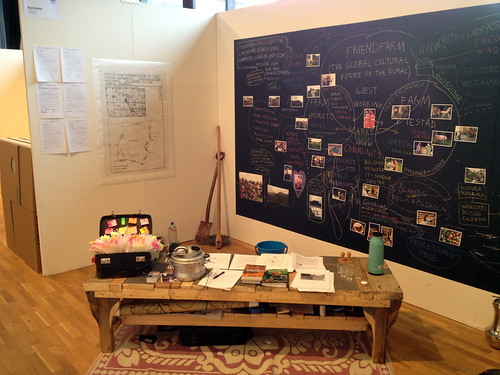
Friend connections between farms
Micro-cooperations for the global
cultural Future of the rural!
The new multinationals
As a visionary, critical project Friendfarm
want to question the structures of globalized economy,
and discuss more sustainable relations between
farms and people over the globe.
Uporoto Farm walk
[AFG_gallery id=’60’]
Uporoto Farm work
[AFG_gallery id=’59’]
Uporoto welcome ceremony
[AFG_gallery id=’61’]
Galijembe primairy school
[AFG_gallery id=’62’]
Study visit ASAS dairy farm
[AFG_gallery id=’63’]
Planting in Dar es Salaam
[AFG_gallery id=’64’]
"It's not the story of the battle; it's the battle of the story!"
Patrick Reinsborough
In the last few years we have witnessed how the corrosion of the three main modes of social imaginary that defined modernity – the market economy, the public sphere, and the self-government of citizens – has reached a critical point. As a result, the increasing number of people in different fields, social scientists, artists, public intellectuals, and activists are calling for rethinking and reinventing social change. Such voices, however, are too often fragmented in their respective boundaries, and, consequently, they have not yet been able to articulate a compelling alternative metanarrative that the public would identify with and which would thus result in a major positive change.
The project Cartographies of Hope: Change Narratives was born out of the sense of urgency and the effort to address this situation. It seeks to bring attention to this condition and to call for joint effort to identify alternatives we can agree. The premise of the project is that narratives of social imaginary play a key role in generating positive changes. Social change is always seen as a certain story, which then becomes an important driver of the change itself. This double function of reflection and agency constitutes
a methodological core of the project.
The last couple of decades have been characterized by the dominant influence of neo-liberal ideology, notably by its narrative about the market mechanisms as natural principles penetrating all fields of social life, including education, healthcare, science, and art. The result is rising inequality, thinning social cohesion, and the fragmentation of polity. In this situation, to simply critique and historicize the neo-liberal system is not enough. We need to connect alternative narratives into a coherent whole –
a metanarrative that would provide us with a sufficient social cohesion
on one hand and openness and hope on the other. The project Cartographies of Hope: Change Narratives comprises of an exhibition, two conferences, workshops, and discussions. Its objective is to map different narratives of social imaginary and to start connecting them to a coherent bigger story, as well as to develop networks and shared databases of individuals and institutions associated with those narratives on local and international levels. The exhibition is organized in several sections and subsections that represent diverse narratives of change, while their sum and sequence indicate a larger picture that may inspire thinking about a new metanarrative:
1. Multitude of social change (local and global, fast and slow, generational and inter-personal)
2. Crises (ecologial, financial and economic, political, moral)
3. Disrespect and protest (forms of disrespect: injustice, inequality, unfreedom, forms of protest, protest movements)
4. Social imagination (solidarity and participation, moral and political dimensions of economy, global respect and justice, humanity and nature)
Exhibiting artists:
Daniel García Andújar, Kader Attia, Eva Bakkeslett, Michael Bielicky and Kamila Richter, Matthew Connors, Teddy Cruz, Amy Franceschini, Alexandra Daisy Ginsberg, Michael Joaquin Grey, Ingo Günther, Toril Johannessen, Fran Ilich, OS Kantine, Krištof Kintera, Kitchen Budapest, Kultivator, Suzanne Lacy, Steve Lambert, Daniel Latorre and Natalia Radywyl, Lize Mogel, Naeem Mohaiemen, Nils Norman, Christian Nold, Sascha Pohflepp and Karsten Schmidt, Morgan Puett, Oliver Ressler, Abu Bakr Shawky, Superflex, Terreform ONE, Krzysztof Wodiczko, The Yes Men and Ztohoven.
On the stone planet Earth, a layer has been added since the beginning of life, 3.9 billion years ago: our between 5 and 20 cm thick layer of top-soil.
In this thin layer, the major part of all biological activity of Earth is going on.
Through our various actions we are either nourishing or depleting this layer.
Adding to this cultural layer might be the most sensible action we will ever perform.
Worm campain office is an installation that promotes and serves guerilla composting in Belgrade. People are invited to join us and make their own compost tower to take out and install somewhere where they think it is good to feed back some nutrition to the soil. Guerilla composting is the 11:th of the “Post revolutionary exercises”, suggestions of how to prepare for a new order, made in collaboration with middle east artgroups in 2011. The whole serie of screenprinted posters reflect works from visiting artist and our group from now back to 2006.
Kultivator for Fittja Open; Top soil take two
Nurturing the soil; gardens – cafe – gardens – cafe…etc
Some composting plans from Kultivator
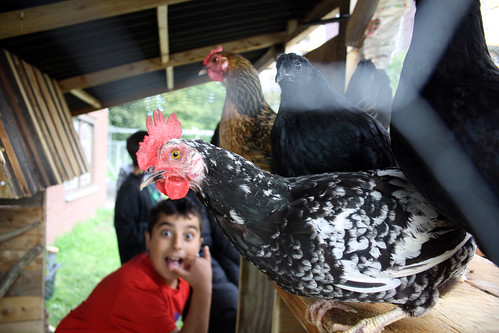
For the café/restaurant at the residency, we would like to install two compost systems: One in form of a chicken coop, that will transform leftover food from the cafe into egg and manure. Leftover food can be thrown in by the guests themselves, in the special opening at the front, (1)The eggs are picked in the box (2) and the manure, (most of it) can be collected from the box (3). The manure should be brought down to the allotment gardens, to fertilize the same soil that the vegetables once grew in. We might mark that somehow by a sign “destination gardens” or some simple illustration.
The second is a raised bed growing curly kale or kitchen kale (its not green cabbage, I think its called curly kale or kitchen kale..) with incorporated in it containers for compost. This compost works with the same principle as the wormtowers, and will let worms transport the nutrition right out to where the vegetables grow, see drawing. In this compost things that chicken does not really like, like potato peel, coffe, fruit peel, teabags, etc could be put, thus more directly from the kitchen.
The chickencoop will stand for two weeks in Sept- Oct, and could after this possibly be donated to for example the allotment gardens, or another group/community if there is interest. Of course this is only an option if there is someone who really wants and knows how to take care of the animals.
The raised bed could be a nice piece remaining close to the house, for those who wants to keep on putting kitchen waste in it. The curly kale will grow on, even under snow (!) The soil around the compost containers insulates the containers, and makes it possible for the composting process to go on also when its cold.
On the stone planet Earth, a layer has been added since the beginning of life, 3.9 billion years ago: our between 5 and 20 cm thick layer of top-soil. In this thin layer, the major part of all biological activity of Earth is going on. Through our various actions we are either nourishing or depleting this layer. The interaction of microorganisms in the top-soil and life above means without exaggeration everything for life’s further progression.
The lack of organic matter brought back to the soil in modern large scale farming is rapidly destroying invaluable top-soil worldwide, putting the whole foodproduction of the future at risk. Recent years guerilla gardening is a fantastic movement, addressing many of the problems connected to industrial agriculture and urban – rural disconnection. For the show Hungry city, Kultivator will make an action of “guerilla composting”, that adds to this practice, and encourages people to feed – back nutrition to the ground they live on.
Prior to the opening, we will dig down a few wormtowers on green spots nearby the exhibition space/area. Inside the exhibition, we will set up a “worm campaign office”, where information on the wormtowers, (how they work, how to make them, why its good, etc) will be displayed, as well as tools, materials and of course worms. During the opening weekend , we will ask visitors to join us and make their own tower to take out and install somewhere where they think it is good to feed back some nutrition to the soil. The worm office will also have a presentation of Kultivators previous works by the poster series “Post revolutionary exercises; ten suggestions of how to prepare for a new order”, reflecting previous projects, from now back to 2006. The Guerilla composting will be the 11:th of these exercises, and a new poster will be made for it. After we leave, for the rest of the exhibition period, the worm office will still be interactive, for those who wishes to make their own wormtower and guerrilla composting action.
A worm tower (vermicompost) is a perma culture method of composting, that simply uses free-ranging compost worms to break down organic waste and then move those nutrients out into the surrounding. A pipe, for example a drain pipe, is dug into the ground, sticking up 10 – 20 cm. Dry organic matter, like leaves or grass, and worms are inserted, and on this you can throw kitchen waste, like leftover food, potato peel, etc. The worms eat the waste and crawl out of the pipe again to spread the processed matter further. The method is often used to direct nutrition to one certain tree. A lid prevent birds or rats from picking the waste out from the top.
[AFG_gallery id=’49’]
1st September to 28th October 2012
Opening: Friday, 31st August 2012, from 7 pm
Hungry City. Agriculture in contemporary art
Funded by Hauptstadtkulturfonds
Curators: Anne Kersten (exhibition), Stéphane Bauer (accompanying program)
There are currently few other topics that make such a pertinent link between art and society as food and nutrition. Contemporary urban gardens are being presented as parts of exhibitions and symposia on philosophy, artists are turning to gardening or farming and chefs are becoming artists – it also seems like few other topics manage to unite so many seemingly contradictory manners and tendencies. Parallel to this, discussions are taking place concerning traditional concepts and methods, small rural business and the cultivation of old varieties of fruit as well as utopian projects, such as inner-city farms. Slow Food, an association of people committed to high-quality, traditionally produced food, has seen a steady increase in its followers over the years, while residents of US cities located in so-called 'food deserts' seem to only yearn after discount stores. Diverse social developments such as these have long been reflected in artistic practices.
The international group show Hungry City follows different directions of the debate and assembles a selection of artistic works that address many different aspects of food production and supply. Contemporary pieces are juxtaposed with works by renowned artists of the 1970s and 80s demonstrating that the issue was already a virulent one within art circles during the past decades. Currently, new art forms such as rural art and urban agricultural projects attempt to clarify the volatile issue and point out changes in stereotypical attributions found in urban and rural areas. Following cultural theoretical exhibitions dealing with food and large-scale projects looking at sustainability, the exhibition Hungry City offers a first-time survey in Germany of agricultural aspects in art from 1960 until today.
The exhibition also focuses on the relationship between town and country and examines these interactions with movements between the two poles playing a role in many respects. This mostly concerns the exchange between food producers and consumers, as well as the changes in food's consistency or physical state during preparation. However, the paths made to transport food are also illustrated: From continent to continent, countryside to city or from the kitchen to the hungry.
Within this context, Carolyn Steel, architect and author of the book "Hungry City – How Food Shapes Our Lives" calls for a parallel perception of urban and rural areas: "Feeding Cities has become rather more complicated than it was in the fourteenth century. But one thing is certain: however much we look the other way, our rural hinterland will always mirror the way we live. Ancient cities were run on slave labor, so were the farms that fed them. Medieval cities thrived on trade, so did their hinterlands. Modern cities, like industrialized hinterlands, have little respect for nature. If we do not like what's happening out there in the landscape, we had better rethink how we eat, because one will never change without the other"
Accompanying program of events: The accompanying program for the exhibition Hungry City in Kunstraum Kreuzberg pursues to emphasize the connection between urban and rural areas, visiting places of food production both here and there. Starting at an urban cultural centre, a series of diverse events hopes to provide a view upon and route towards near and distant surroundings.
Artists (preliminary selection): Sonja Ahlhäuser (D), Maria Thereza Alves (BRA / I), Yekaterina Anzupowa (D), KP Brehmer (D), Agnes Denes (USA), Letitia El Halli Obeid (ARG), Fall Fruit (USA), Amy Franceschini (USA ), Fernando Garcia Dory (E), Sun Green Fort (DK), cultivator (SE), Kristina Leko (CROA), Ulrike Ludwig (D), Matthew Moore (USA), MyVillage (NL, D, UK), Henry Riebesehl ( D), D Antje Schiffer & Thomas Sprenger (), Bonnie Sherk (USA), Lukasz Skapski (PL), Asa Sonja yolk (SE / D), Daniel Spoerri (D), Superflex (DK), Insa Winkler (D), Christa Zeißig (D)
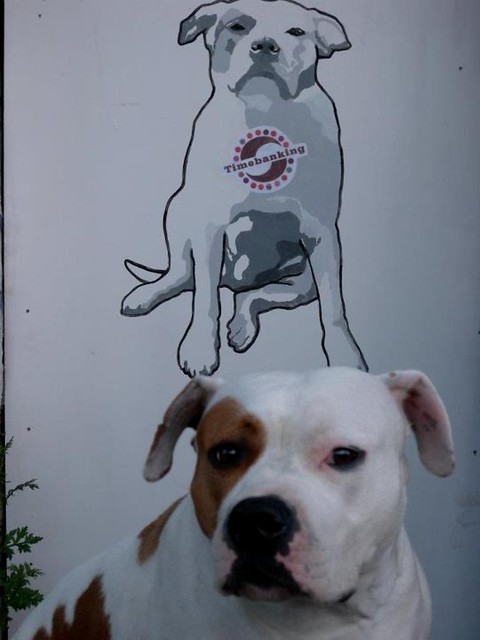
In this time we will present and perform time banking, a form of alternative economy.We hereby invite all who would like to work/exchange time to improve the backyardand front facade of the house from 15th – 17th of june.The work will end with the Backyard feeding party the 17th of june at 19.00.
the Timebank
“From each according to his abilities, to each according to his needs.”
Louis Blanc
The collaboration-form the Timebank started with a couple of families on Öland, Sweden, in 2010, and is now involving about 10 households, with activities about 10 times a year.
Briefly, the Timebank is a simple structure for exchange of time and work between the participants. The exchange enables large labor-intensive effort for maintenance or new construction to homes, farms, festivals, weddings, etc., with minimal financial effort. Once a participant has a need to get a job done, it is advertised on the group’s Facebook page, date and time are determined, and anyone who can shows up and contribute what they can, until the work is done. Food, drinks, sleeping-place and nice atmosphere is on the one who invites. The Timebank does not count hours or credits, but is based entirely on the participants’ idea of what they can and want to contribute, and what they should get back, according to the famous principles of French socialist Louis Blanc.
Kultivator is one of the founders of the Timebank, others are artists, small farmers, musicians, teachers, carpenters, etc, with all in common that they try to restore or maintain cheap but old and often derelict buildings in combination with small companies or enterprises.
The Timebank was not set up as an artproject, but evolved out of a practical need and has become an important part of social life on the island, often replacing the more traditional “sitting down and talking” party.
A policy is a governing document with the overall intentions for the area the policy covers. The review provides guidelines to facilitate development.
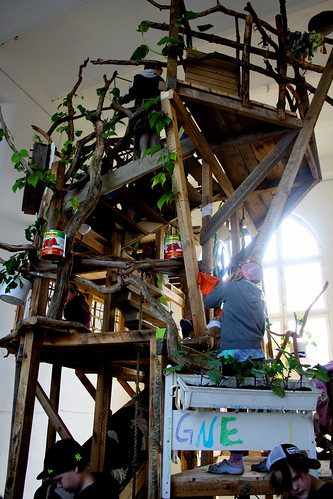
Kultivator has in spring 2012 worked in a creative school project with children in grades 4 and 5 of Gnesta municipality. The aim of the work has been to create tools for communicating and visualizing desired future scenarios. The focus has been on spatial capabilities, form and system for highrise building and living many together. Work began with sketching and brainstorming in the schools,
and continued inside Artlab Gnesta´s exhibitionspace, with the construction of a three- dimensional policy document that is read by playing. The relationship art – reality and the role of vision, in both cases, is explored in a social sculpture, designed and constructed by a total of nearly 100 people.
Visions and ideas: grades 4 and 5 in Kvarnbacka, Laxne, and Welandersborg schools, approximately 50 kids age 10 -11
Interpretation and construction: Mathieu Vrijman, Jonas Rahm, Alexandre Chapus, Adam Nyandikila, Rasmus Jeppsson, Malena Rahm, Marlene Lindmark, Mia Lindaregård and Malin Lindmark Vrijman. Building kids: kids Ivar and Moa Vrijman, Morgan Stigeborn, Theo and Nora Rahm and Alva, Joel and Signe Jeppsson.
Gnestopia is part of Artlab Gnestas “Green year” and opens June 2 at 12:00 to 17:00., together with the videowork “Grassworks”, by Emma Göransson. On the opening day is also held a release party of the new journal “Fält” and launching of Patrick Dallarts floating islands. For more info, see www.artlabgnesta.se
On the stone planet Earth, a layer has been added since the beginning of life, 3.9 billion years ago: our between 5 and 20 cm thick layer of topsoil. In this thin layer, the major part of all biological activity of Earth is going on. Through our various actions at the place we live or work, we are either nourishing or depleting this layer. The interaction of microorganisms in the topsoil and life above means without exaggeration everything for life’s further progression.
It is as big – and as small – as anything …
For Botkyrka Konsthall, Kultivator makes The Top-soil tombola, a compost bin for the gallery’s visitors and staff. Inside the institution it becomes its own cultural producer, who works during the show to prepare the foundation for any further activity: top soil, the planet’s tenuous utmost cultural layer.
Visitors and staff in the gallery are asked to put their organic waste in the tombola, and then turn it to mix and aerate the process. Then the cultures of bacteria and microorganisms work on for themselves. In September, in time for the Fittja Open, about 50 liters highly cultured local soil, have been formed to continue growing.
[AFG_gallery id=’41’]
Top-Soil project of Kultivator in Botkyrka is also, and perhaps more importantly, taking place outside the art gallery with an installation of a “worm tower” (vermicompost) in connection with allotment gardens, and a call for creating your own compost and composting on the balcony, in the allotment garden, or in public green spaces.
In the summer of 2012, Kultivator will work further on the concept in Botkyrka, and at Fittja Open in September, the final results of this fieldwork will be presented.
The inspiration for Grans´ University, comes from the initiative of Mrs Vendana Shiva, India, that started up her Grandmothers university in Navdanya, North India, in 2003. “..is aimed at both celebrating and validating the wisdom of our grandmothers, as well as transmitting this to future generations…”
What drew our attention, was that she did this as a reaction on the 9.11 attacks in 2001. The idea of turning to the grandmothers when times get hard inspired us, since they are not usually considered the ones that have the answers when it comes to great challenges of the future.
We are now, far more than terrorism, facing enormous challenges considering the management of resources. At this moment in time, we have the possibility to turn to the last generation in our part of the world that was still around before consumption-society really kicked in.
The show consists of the ornamental notes from Kultivators study trip to Solberg,
North Jämtland, spring 2012.
We decorated the toilet of the artbuilding in honour ofDr. Bindeshwar Pathak, founder of the many times awardedSulabh Sanitation Movementin India. His work is an example of a single individual’s initiative that has led to increased well-being of millions. Since its inception in 1970 the movement has installed more than one million Sulabh toilets, which in addition to giving people and especially women in slum areas, access to clean and safe toilets, also reduced the need for India’s dirtiest and most degrading occupation; excrement collector. Just the fact that the Sulabh Sanitation Movement in its starting point is a social project, makes it especially interesting to hold up as an example of sustainable development. We would suggest that ecology, culture and social structures can never be detached from each other, and that all work for a better environment must function as well culturally and socially as ecologically.
Like the toilets developed by Dr. Bindeshwar, this Mullis toilet has a container that collects the excrement, so that it that after some time can be used as fertilizer. The microorganisms that make this possible, Jumptails, are also presented in the room in drawings by Kultivatormedlemmen Jonas Rahm.
This is the tribute nr 2. It is estimated that about 80% of all organic material on the planet passes through these microorganisms digestive system. They are with this a prerequisite for all emerging and hence all life on earth. Without these organisms, invisible to us, we would not last one day. Agriculture may now be conducted “without soil”, with artificial nutrient solutions supplied to for example tomato plants. But the job to break down our stools, and the remains of, for example, a tomato salad, we have no synthetic method for.
For Barents Spektakel the Swedish groupKultivator will try to process a cheese
with mixed milk from the four countries of the Barents Region.
To develop the Barents cross-culturalcheese, they will work with the local cheese-master
Ivar Øverliand get herbal advice from the local Sami people,
as well as use the festival energy to stimulate its fermentation.
The project will be carried out at the exhibition space,
and samples of the first cheese will be served at the seminar Visionary Arctic.
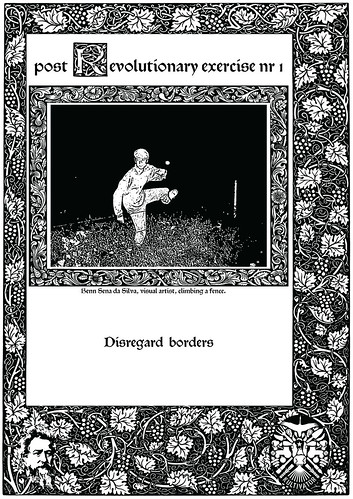
The post (r)evolutionary exercises are the outcome of a meeting/friendship/project that started in summer 2010, when we took part in "Goings on" seminar in Beirut, Lebanon. In this seminar, curated by Cecilia Andersson, Scandinavian and Middle east art groups were invited to meet and learn about each others practices. That's what we did, we got along really well, and we started at once to think of ways to do something together again. After the seminar, The Danish group rum46 applied for money to get everyone to Denmark and Sweden in summer 2011, in a project called Camp.
Then in between, as we know, the Arabic uprising came – our new friends stood on the Tehrir square, or struggling in Damascus and so on, and we felt that when they came to us, that is what we wanted to talk about; What now? What do you do after the revolution? We wanted some kind of physical outcome of the talks, and choose posters, also so that we could distribute them to the people taking part afterwards. And then finally, in August 2011, when everybody (except sadly, the Syrian group that did not dare to travel because of the violence in Damascus) had arrived and were gathered on the farm, we all as usual began to do "the farm things", (like slaughtering, fencing, milking, etc,) someone came up with that "this is actually what you must do after the revolution"; building up again. So we discussed, and sketched, and identified these "exercises". Intended for anyone who hopes to live through a revolution. They are illustrated with pictures from projects we have made, some from the actual meeting that summer with the Middle East art groups, and some from previous events taking place on the farm.
And yes, we took the design from a manuscript of William Morris, the radical frontiers person of the Arts and crafts movement in the late 19th century in England. Nowadays, these patterns are popular interior decorative, but then they represented a criticism on industrialisation and its enslavement of the masses. It had nothing to do with bourgeoisie or elitism, just like we don't believe that art or farming should be elitist, or conservative. I suppose the design kind of underlines this contradiction on the surface, to be radical and yet traditional. We like to play with that.
The posters have been shown at Alt-CPH 11 and V.art 11, where they were given away with wallpaper glue and pencil in a nice bag if people would hang them in the public space.
Lunch with cows
28th August in Tammenpää milk farm
in western coast of Finland.
The framework of the event is Halikonlahti Green Art-project,
an initiative of artist and curator
Tuula Nikulainen andSunny Future association.
The exhibition, called Food Chains,
will be opened at Salo Art Museum
next Friday, 9th September.
It is curated by Tuula Nikulainen
and Ulla Taipale. More information
about the exhibitionhere.
photos: Sami Perttilä, AndreaVanuchhi
Since almost ten thousand years now, we live very close to each other, and has indeed affected each others lives and beings a great deal. Our relation has been practical and very close physical, but we have not yet really grown into exchanging a lot of thoughts, or even trying to meet at an intellectual level. This informal lunch meeting intends to be a small start of a more mature and interesting way of being together. We have no prepared speakers, no translators or list of topics that must be discussed, but! Questions about our future relation, and sustainable survival may come up!
-A cross cultural workshop in rum46 with the artist groups from the first Goings On
– a seminar organized by Cecilia Andersson that took place in 98weeks project space in Beirut Lebanon
from the 24-27 June 2010.
Goings On participants were: Cecilia Andersson / werkprojects
(Sweden), 98weeks project space Mirene Arsanios (Lebanon), Iz Östat / cura bodrum residency
(Turkey), Mohamed Allam / Medrar (Egypt), Luba Kuzovnikova / Pikene på Broen (Norway), Malin &
Mathieu Vrijman / Kultivator (Sweden), Thorbjørn Reuter Christiansen / rum46 (Denmark), Alicia
Jimenez / El Hervidero (Spain), Omar Khoury / Samandal (Lebanon), Khaled Sedkis / Interruptions
(Jordan). (See attachment from Goings On in Beirut and the brief CV of the participants)
Description:
Workshop ”The camp” will take place in rum46 from arrival of the artists on 9.8.2011 until their
departures on the 17.8.2011. The aim is to follow up on the participant’s art practices and to know
each other better.
We want to develop “a factory of ideas”, which will be a cross-cultural collective happening doing the
workshop. Participants will be asked to bring “materials” from their cultural background; this
“material” will be used in shaping the process. In the evenings, during the workshop in rum46, there
will also be public presentations from the different groups and social dinner parties. Together the
artists will make a collective exhibition that will be shown in rum46. This exhibition will become the
rum46´s summer exhibition and will be shown until the end of August 2011.
After the workshop,
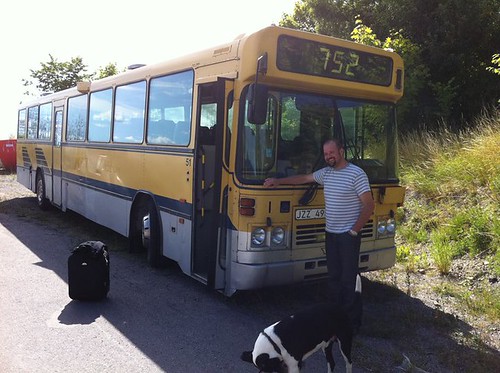
from the 13.8.2011 to 17.8.2011, the participants will visit the artist group Kultivators farm on Öland
in Sweden and learn about the fusion of agriculture and art.


 A bike shed with a green roof.




 see the site for more info

 a methodological core of the project.





 28/4 – 20/5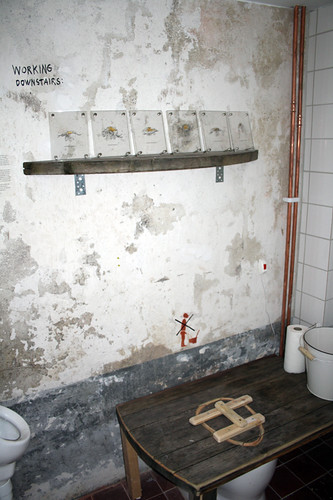

 The
The 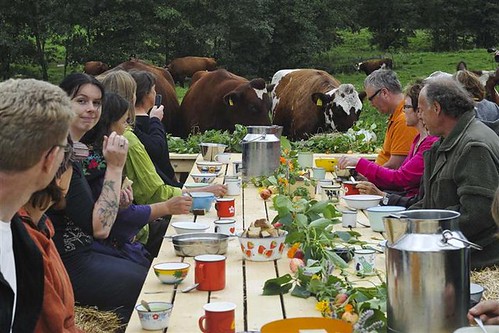 Lunch with cows
 WORKSHOP ”The camp”